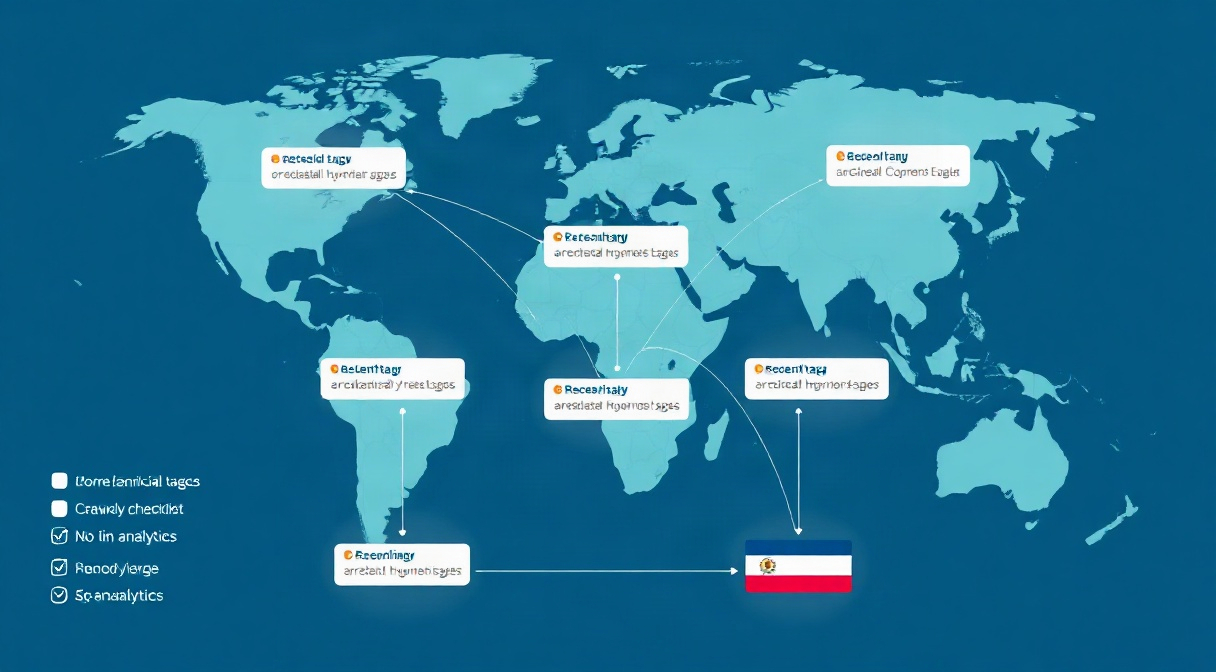
Serving several countries or languages can create a confusing set of near-identical pages unless search engines understand which version belongs to which audience. A disciplined international seo hreflang plan connects each localized URL with its language and, when appropriate, its country. It also depends on sound regional architecture, consistent canonicals, and pages that deserve to be indexed in the first place.
This guide walks through those decisions in a practical order: map audiences and URLs, implement annotations, prevent conflicting signals, test the result, and maintain it as the site grows. The goal is not simply to add tags. It is to help search engines select the right page for each market without splitting signals or creating needless indexation problems.
1. Choose Regional Architecture Before Writing Hreflang
Hreflang describes the relationship between eligible pages; it does not decide how your international URLs should be organized. Make the architecture decision first, using your actual audience, operational capacity, and content differences. Common options include country-code top-level domains such as example.fr, subdomains such as fr.example.com, and subdirectories such as example.com/fr/. Each can work. The best choice is the one your organization can maintain accurately and consistently.
A ccTLD sends a clear country signal and can support strong local branding, but it often requires separate domain management, analytics configuration, and authority building. Subdirectories keep country and language sections under one domain and can simplify technical governance, although their country targeting is less explicit than a ccTLD. Subdomains offer flexibility but may introduce additional management and measurement work. These are trade-offs, not ranking guarantees.
Build a market-and-language inventory before selecting URLs. For example, a business might serve English speakers in the United States and United Kingdom, French speakers in France and Canada, and Spanish speakers across several countries. Do not assume one URL per country is necessary: if the content, offer, legal details, and customer experience are genuinely the same for multiple markets, a shared language page may be appropriate.
Conversely, do not combine pages just because the language is shared. A French page for France may feature euros, local delivery terms, and French regulations, while a Canadian French page may use different pricing, availability, spelling, and support details. Those are distinct audience experiences and can warrant separate URLs. Search engines cannot infer all those distinctions from a flag icon or a country selector; the page itself and its technical signals must be clear.
- List each target country, language, and intended landing page.
- Record which elements are localized: currency, products, shipping, compliance, spelling, and contact options.
- Choose a stable URL pattern and document it for editorial, development, and analytics teams.
- Decide whether a language-neutral selector page or an x-default destination is useful.
This is where a deliberate multilingual site structure prevents later rework. Avoid creating thin country pages solely to add a location term. If a market does not have a meaningful localized experience yet, a strong shared-language page may be more useful than an empty regional variant.
Finally, distinguish geographic targeting from language targeting. A language code identifies the language of a page; a region code narrows the intended audience where needed. For instance, en-GB and en-US are different regional language variants, while fr-CA specifies French for Canada. Choose tags that correspond to real pages, not every theoretically possible market. Hreflang is a mapping of available equivalents, not a request to manufacture more URLs.
2. Implement International SEO Hreflang Correctly
Once each market has a stable URL, create a complete cluster of equivalent pages. Each localized page should identify itself and every other equivalent version with hreflang annotations. The connected pages should also point back to one another. This reciprocal relationship helps search engines verify that the URLs are deliberate alternatives rather than unrelated pages that happen to share a template.
Suppose a product page has three versions: US English at https://example.com/en-us/widget/, UK English at https://example.com/en-gb/widget/, and French for France at https://example.com/fr-fr/widget/. Each page should include the same set of alternate references, including its own URL. A simplified HTML implementation on all three pages would look like this:
<link rel='alternate' hreflang='en-US' href='https://example.com/en-us/widget/' />
<link rel='alternate' hreflang='en-GB' href='https://example.com/en-gb/widget/' />
<link rel='alternate' hreflang='fr-FR' href='https://example.com/fr-fr/widget/' />
<link rel='alternate' hreflang='x-default' href='https://example.com/widget/' />
Use valid language and optional region codes. The language subtag follows standard language-code conventions, and the region is generally an uppercase country code. The order is language-region, so en-GB is valid while GB-en is not. Use the region only when the page is genuinely intended for that market. A Spanish page intended for all Spanish speakers may use es rather than inventing separate regional tags without separate destinations.
Every URL in the cluster should be absolute, crawlable, and return a successful response. Do not point hreflang to a redirect, a blocked URL, a noindex page, or a canonicalized-away duplicate. The target needs to be a usable, indexable page. If your site uses a trailing-slash convention, follow it consistently in the tag values and the page’s internal links.
You can implement annotations in HTML, XML sitemaps, or HTTP headers for non-HTML files. HTML is often easiest to inspect for a moderate site; an XML sitemap can be practical when teams generate localized relationships centrally. Avoid publishing conflicting versions of the same mapping through several systems unless there is a clear source of truth. The data must stay aligned regardless of implementation method.
Include x-default when there is a language or country selector, or a genuinely useful fallback page for visitors whose language or market does not match a listed alternative. It is not a mandatory tag for every cluster, and it does not replace the specific language-region URLs. Never send all unmatched users to a page that blocks their access or makes a market-specific assumption that is likely to be wrong.
For a scalable international seo hreflang workflow, store the relationships as structured data rather than hand-editing tags on hundreds of templates. Each row can contain a page identifier, locale, canonical URL, and its alternate URLs. Generate tags from that approved source, then test the rendered output. This reduces mismatched links caused by copy-paste and lets content teams see precisely which pages belong to each cluster.
3. Align Hreflang, Canonicals, and Indexation Signals
Hreflang is not a substitute for canonicalization. Canonical tags indicate which URL should represent duplicate or substantially similar content; hreflang indicates which localized URLs are alternatives for different audiences. Confusing those jobs is a common source of international indexation errors. In a typical localized cluster, each distinct country-language page should have a self-referencing canonical, while hreflang connects it to the other regional versions.
Consider two product pages with different currencies, shipping promises, and legal information. If the UK URL declares the US URL as canonical, it tells search engines that the UK page is not the preferred representative. Adding an hreflang reference back to the UK page does not reliably undo that conflict. Review canonicals and hreflang together, and make sure each live localized page has consistent, intentional signals.
There are exceptions: a regional URL that contains no meaningful unique value and is truly a duplicate may be better consolidated than maintained as an independent indexable page. But consolidation means accepting that the duplicate should not act as a separate search result. Do not keep a set of country URLs merely to place them in hreflang if they all canonicalize to one destination; create a useful localized experience or simplify the cluster.
Check other directives that affect eligibility. A noindex directive removes a page from search results; robots.txt can prevent crawling; a redirect makes the source URL unavailable as a stable alternate. A URL that appears in hreflang but cannot be crawled, indexed, or selected as canonical contributes a weak or contradictory signal. Review rendered HTML, response headers, robots rules, and sitemap inclusion for every target.
International duplication does not automatically mean cannibalization. Search engines can understand equivalent language or regional alternatives when the signals are coherent. More often, problems arise when several pages target the same audience without a clear distinction, or when internal links, title tags, and content imply a different market from the annotations. For example, two English pages with identical products and no local differences may compete for the same users if one is intended for the US and the other is labeled for the UK but both present US shipping.
- Use a self-referencing canonical on each distinct, indexable regional page.
- Keep hreflang URLs aligned with canonical URLs, not alternate tracking or parameterized versions.
- Ensure translated pages are substantive and not machine-generated doorway pages with little user value.
- Use internal navigation and XML sitemaps to reinforce the same preferred URL patterns.
Do not force visitors or crawlers to a single country page based solely on IP address. Automatic redirects can prevent users and search engines from reaching alternatives and can create an unpleasant experience for travelers, VPN users, or people who prefer another language. A visible country selector is usually safer; if you suggest a location-specific version, preserve the ability to choose another.
For practical geo targeting search engines, treat hreflang as one signal among several, not a switch that guarantees a specific ranking location. Search engines also consider page content, links, domain signals, user experience, and the searcher’s context. Make the regional intent visible in the page copy, currency, contact details, and delivery information, and keep those details consistent with the URL and annotation.
4. Validate the Cluster With Crawls and Search Data
Quality assurance should test relationships, not merely confirm that a tag exists. Start with a crawl of the rendered site or a representative URL sample. A crawler configured to extract hreflang can report missing return links, invalid codes, non-200 destinations, redirects, and alternate URLs that are blocked or marked noindex. Review the export by cluster: a single missing reciprocal reference can affect the relationship even when the other pages look correct.
Tools such as Screaming Frog SEO Spider can crawl internal URLs and report hreflang implementation issues when configured to collect the relevant data. The exact report depends on your crawl settings and the implementation method, so include XML sitemap processing or HTTP-header checks where applicable. A spreadsheet is useful for a small launch: compare the expected URL list against the live annotations and record status codes, canonicals, indexability, and language-region values.
Use a test case before rolling out templates across the whole site. Pick a cluster with a few locales and verify the source response, rendered tags, canonical, robots directives, and alternate destinations. Then test a page with no localized equivalent, a discontinued product, and a newly launched market. Edge cases expose assumptions that a simple homepage test will miss.
Search Console can help assess whether pages are being crawled and indexed, and whether impressions arrive from intended countries or language markets. It does not provide a universal real-time hreflang pass/fail dashboard, so combine its coverage and performance reports with a technical crawl. Compare landing pages and query patterns by country over time; investigate whether the wrong locale is receiving impressions, rather than assuming every ranking fluctuation is caused by hreflang.
Useful validation checks include:
- Every alternate URL returns the intended page without a redirect chain or soft 404.
- Each page lists itself and the other valid equivalents; references are reciprocal.
- Language and region codes match the page’s actual audience and content.
- Canonical URLs, hreflang URLs, internal links, and sitemap URLs are consistent.
- There are no accidental noindex directives, blocked resources, or conflicting HTTP headers.
For a deeper background on common implementation patterns, consult Search Engine Journal’s hreflang guide and compare the technical recommendations with current search engine documentation before deployment. Use your own crawl and rendered source as the operational truth: a guide explains principles, while your website’s output reveals what users and crawlers actually receive.
After launch, monitor errors on a schedule that matches release frequency. A high-change ecommerce site may need automated checks on every deployment; a small brochure site may use a monthly crawl and checks after localization releases. Keep a baseline export of known clusters, so newly missing URLs or unexpected language mappings are visible. Track changes in indexable URL counts and country-level landing pages alongside crawl errors, rather than treating a tag audit as a one-time project.
If a tool flags an issue, prioritize by affected URLs and business value. A broken annotation across every template deserves attention before an isolated retired page. Fix the source system where possible, then recrawl and verify the live output. Simply editing a report or resubmitting a sitemap does not repair an incorrect template.
5. Govern Regional Pages and Measure Market Fit
International SEO is an ongoing publishing system, not a one-off code release. Assign clear owners for locale data, URL creation, translation review, technical templates, and measurement. Without this governance, editors may launch a new country page without adding it to the alternate cluster, while developers may update a template that silently removes the self-reference. A compact locale registry prevents each team from maintaining a different version of the truth.
For each page or content group, record its canonical URL, locale, publication status, indexability, and approved equivalents. When a page is retired, decide whether to redirect it to a genuinely comparable replacement, return a useful gone status, or maintain it. Then update every remaining page in the hreflang cluster and remove obsolete sitemap entries. Do not redirect every discontinued local URL to a generic homepage; that can confuse users and obscure the page’s former purpose.
Editorial review matters as much as deployment. Translation alone may leave a page culturally or commercially wrong: local product names, units, payment methods, claims, dates, and customer support details may need adaptation. Have a native or qualified market reviewer validate high-value landing pages. This reduces the risk of a technically perfect URL sending visitors to content that does not meet local expectations.
Measure success by market and landing page, not just by the total number of international sessions. In analytics and Search Console, segment organic impressions, clicks, click-through rate, indexed URLs, conversions, and engagement by country or landing-page locale. A rise in clicks to the correct UK page while the US page continues serving US users is a healthier result than a simple increase in total traffic accompanied by locale confusion.
Use diagnostic questions to interpret changes:
- Are impressions for a country landing on the intended regional URL?
- Did the wrong locale’s clicks rise after a template or redirect change?
- Are localized pages indexed and canonicalized as expected?
- Do users reach the selector and successfully switch markets when needed?
- Are conversions lower because of technical errors, or because the offer is not locally relevant?
Do not treat a country-specific ranking report as proof that hreflang alone caused a change. Seasonality, competition, backlinks, translations, inventory, and algorithm updates also affect performance. Annotate releases and compare like-for-like periods. If two pages continue to compete for the same queries, review their audience distinction, local content, internal links, canonicals, and hreflang mappings together.
As your regional footprint expands, apply the same architecture rules to new markets rather than improvising a URL format for every launch. If the business later changes currency, fulfillment, or legal coverage, reassess whether one page still serves several regions adequately. A multilingual site structure should reflect how the business serves people now, while keeping future localization manageable.
This governance approach makes geo targeting search engines more reliable because the technical signals match the live experience. Establish a release checklist: confirm content approval, URL and canonical, reciprocal hreflang, sitemap presence, internal links, indexability, and analytics annotation. For additional international planning resources, explore GlobalSEOFlow and build a repeatable workflow for your next market rather than patching problems after launch.
Frequently Asked Questions
Do I need hreflang if my pages are translated?
Not necessarily for every translated page, but hreflang is useful when you maintain equivalent pages for different languages or regional audiences and want search engines to understand their relationship. First ensure each page is valuable, crawlable, and indexable. A translation with no regional equivalent does not require a large alternate cluster.
Should each country page have a self-referencing canonical?
Usually, yes, when it is a distinct, indexable regional page with meaningful localized value. Its canonical should point to its preferred URL, while hreflang links it to equivalent locales. If pages are true duplicates and should consolidate, decide that through canonicalization rather than pretending they are separate regional results.
Can I put hreflang only in an XML sitemap?
Yes, sitemap annotations are a supported implementation method, as are HTML link elements and HTTP headers for suitable file types. Choose a method your team can generate and validate reliably. Keep the relationships complete and reciprocal, and avoid conflicting mappings between implementations.
Will hreflang guarantee that users see the correct country page?
No. Hreflang helps search engines understand language and regional alternatives, but it is not a ranking guarantee or a substitute for useful local content. Support it with consistent URLs, canonicals, internal links, and market-specific details, and provide visitors with a clear way to select another region.
Conclusion: Make Every Locale Clear
Reliable international seo hreflang begins with a sensible regional architecture and ends with ongoing validation. Map real audiences to useful pages, connect those pages with reciprocal annotations, align canonicals and indexation directives, and monitor whether the intended URLs appear in each market. A sound process reduces avoidable duplication and helps search engines choose the right content for the right audience.
Review your locale inventory and crawl a representative cluster before your next international launch. For help shaping a practical global search plan, visit GlobalSEOFlow.com.